The brochure timeline, and what MRI studies actually find years later.
Up to 15 yearsHow long hyaluronic acid filler has been detected after treatment. The brochure said months.
By Trey Coppola, founder of Rinnova·October 1, 2026·5 min read
Filler is marketed with tidy timelines. Six months. Twelve months. Eighteen if you splurge on the premium syringe. But ask around and you will hear a different story: lumps years later, swelling that comes and goes, problems long after the filler was supposed to be gone.
Here is what is actually known about how long filler lasts, what can go wrong, and why knowing exactly what is in your face is not optional.
These numbers come from clinical trials measuring visible correction, meaning how long the area still looks filled. They do not mean the product is fully gone afterward.
What the research actually shows
This is the part most people never hear. A 2024 study of 33 patients using MRI found hyaluronic acid filler still present in every single patient, with no complete dissipation over the study period. Among them, 21 had not been injected for 2 to 5 years, 12 for over 5 years, and some showed filler up to 15 years after treatment (Master et al., Plastic and Reconstructive Surgery Global Open).
All 33Patients in the MRI study still had filler present. None had fully cleared it.
2.8×Measured filler volume versus the amount originally injected, in a separate 3D MRI study.
That second study found something even stranger: detectable filler up to 15 years post injection, with volume on average 2.8 times greater than what was put in (PMC). Certain fillers appear to expand rather than gradually diminish.
The filler may stop giving you the look you paid for, but that does not mean your body has cleared it. It can sit there quietly.
Quiet does not mean harmless.
Potential side effects, including the late ones
Most people know about bruising and swelling right after treatment. The late complications are less discussed:
Delayed nodules and granulomasFirm lumps that can appear months or years later, sometimes triggered by illness, dental work, or vaccines. Delayed-onset nodules occur in about 0.5% of HA filler treatments, typically four weeks to over a year post treatment, driven by delayed inflammation or bacterial biofilms (EyeWiki, American Academy of Ophthalmology). Foreign body granulomas can develop several months or even years after injection (PMC).
Chronic or recurring swellingIntermittent puffiness in a treated area that flares up and settles down, sometimes for years. Late-onset inflammatory reactions are rare but documented, sometimes triggered by flu-like illness, and believed to be immune-mediated (PMC).
Filler migrationProduct moving from where it was placed, most famously above the lip or around the eyes. Migrated filler can cause delayed-onset nodules months to years after treatment (EyeWiki).
Tyndall effectA bluish tint under the skin, common with superficial under-eye filler.
Vascular occlusionRare but serious: filler entering a blood vessel, which can cause tissue damage or, in the worst cases, vision loss (PMC). This is an emergency, and it happens at the time of injection, not years later.
The dissolving trapHyaluronidase can dissolve hyaluronic acid filler, but "dissolved" does not always mean the story is over. Inflammation can persist. Tissue changes can persist.
This is general information, not medical advice. If something feels wrong, see your provider or a dermatologist.
A real story: six years later
From the founder
I had Juvederm placed under my eyes in 2020. Since then I have had it dissolved, and I am still dealing with flare ups six years later. I am currently on two medications to manage it.
Nobody told me in 2020 that this was a possibility. The conversation was about how great I would look at week three, not about what could still be happening in 2026.
I am not telling you this to scare you away from filler. I am telling you because it is the reason Rinnova exists. If I had a complete record, every product, every syringe, every date, every provider, I would have been in a far better position every time I sat in a new doctor's office trying to explain what was happening under my eyes.
All four photos below are mine, two before-and-after pairs taken three years apart. No makeup, no filters, raw photos.
2023, three years after the injection:
2023, no flare-up2023, during a flare-up
2026, six years after the injection:
2026, no flare-up2026, during a flare-up
Why you need to know what is in your face
Three situations where your filler history stops being trivia:
01
Something goes wrongA new provider, an ER visit, a delayed reaction years later. "I think I had Juvederm, maybe 2021?" is not a medical history.
02
You want it fixedDissolving, correcting, or layering new filler over old requires knowing what is already there. Different products behave differently, and guessing wastes money at best.
03
You switch providersWhich happens constantly in aesthetics. Your new injector should not be starting from zero.
On your face
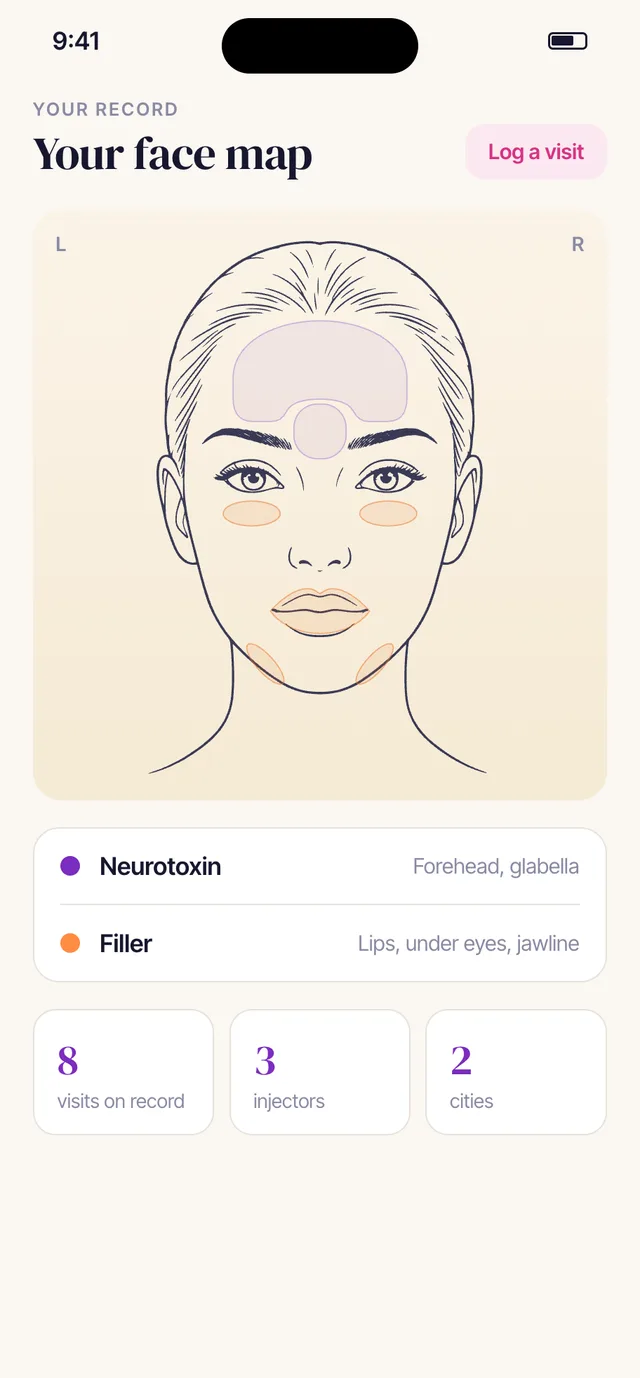
Every product, mapped and dated
What went where, when, and by whom.
The fix
Keep a record of every treatment: product name, amount, placement area, date, provider, cost. Photograph the area over time. Note any reactions, even minor ones, with dates.
That is what Rinnova does. It maps your full aesthetic treatment history so you always know exactly what is in your face, and it reminds you when results are wearing off. Free on the App Store.
Sources
Juvederm product durations from clinical studies and FDA summaries. Drugs.com
Master et al. (2024), "Hyaluronic Acid Filler Longevity in the Mid-face: A Review of 33 Magnetic Resonance Imaging Studies." Plastic and Reconstructive Surgery Global Open. DOAJ
3D MRI volumetric study: filler volume averaging 2.8x injected amount, detectable up to 15 years. PMC
Rinnova describes your own record back to you. Durations and findings here are general information drawn from published research, not medical advice, and not a clinical opinion about you. Decisions about what to have done, whether to dissolve, and when, belong between you and a qualified provider.